Clinical Psychology & Psychoanalysis

I work with people who, on the whole, function well but feel caught in patterns — of thinking, feeling, or relating — that they don't fully understand and can't seem to change. Many have been in therapy before and are looking for something more substantial: a treatment that takes the mind seriously rather than offering reassurance, coping strategies, or advice. As a licensed psychologist and certified psychoanalyst, I offer that kind of sustained, rigorous attention.
What makes this approach distinctive (aside from meeting two or more times per week) is that it isn't primarily a conversation — at least not in the usual sense. Rather than discussing your problems and working out strategies, I pay close attention to how your mind works: how it organizes experience, when it stays open and operative, and when — and how — it constricts or contorts itself instead. As I come to know these patterns and the meanings they express, I can show them to you more and more clearly; and as you begin to see them too, your perspective shifts. You begin to recognize the shape of what you'd been caught within. Links to the past clarify and new options for the present and future open up. The aim is growth and change through self-knowledge, and the rest of this site explains how that process works, and why.
Dr. Jonathan Shedler, a psychoanalyst, explains how this kind of therapy is different. His research on its effectiveness is here.
How It Works
The mind is a meaning-making engine. Psychoanalysis makes its patterns visible.
The Mind Creates Meaning
The mind is a machine that constructs the ideas through which we see and experience ourselves, others, and the world generally. Sometimes these ideas distort things more than reveal them.
Patterns Take Root
When things are working well the mind is able to detect mismatches between the idea and the world itself, and update its construction processes accordingly. Sometimes, though, this updating process fails and patterns of experience are repeated again and again.
Patterns Surface in Treatment
The analytic setting works by making the mind's patterns visible. The analyst is in a position to observe or study your mind's construction processes as they work.
Understanding Brings Change
When you can begin to see how your mind is bending your perceptions into familiar patterns again and again, you begin to understand that there are reasons for why this is happening. Understanding those reasons hurts but frees the mind from old patterns which makes it work better and more efficiently.
Common Questions
Answers to the questions prospective patients ask most.
-
The financial aspect of treatment really needs to be talked through in person. Though I still do accept some insurances, I am increasingly shifting my practice to a fee-for-service model. If your plan includes out-of-network benefits, your insurance may reimburse you for a meaningful portion of each session — I can provide the receipts (called superbills) you would submit, and this guide explains how that works. I know the cost of treatment is significant, but so too is its value. I offer consultations — at least two sessions within a week — as a chance to meet and get a feel for one another. And if we can't find a workable fee, I'll keep the cost of the consultation modest and gladly help with referrals to other clinicians. Call me — I'm happy to talk things through with you.
-
At least twice weekly, consistently over time. Meeting twice weekly is considered psychoanalytic psychotherapy, whereas meeting four or five times weekly is considered psychoanalysis. The difference is one of intensity and possibility. An analysis is a much fuller experience, but psychoanalytic psychotherapy is still experiential, richly meaningful, and very effective.
An analysis doesn't always make sense and isn't always recommended. I tend to start with patients at a frequency of twice weekly and let things unfold for a number of months or even a year or more. Then, as we get a better sense for how well we work together and how your mind is structured, it may or may not make sense to consider converting to an analysis.
-
Psychoanalytic work deals with the structure of your thoughts, not just their contents. When you talk in a session — even when you're describing people and events from another time and place — you're also conveying something else: information about how your mind is working right now, in the act of thinking and speaking. What reaches me is never the events themselves. The events you're describing have already been interpreted. What we need access to are those automatic processes of interpretation, not their products.
That's the aim. The question of frequency is really a question about what makes that access possible, and there are three honest answers.
The first is continuity. With a week between meetings, each session largely starts over. A thread that opened on Tuesday has gone cold by the following Tuesday, and you arrive with a week of accumulated life that seems to demand reporting. Much of the hour gets spent updating me. At higher frequency, the reporting function falls away — there's simply less to report — and what remains is your mind, working, in front of both of us.
The second is momentum. The central activity of this work — loosening your control over your own mind and letting thoughts surface as they come — is genuinely difficult, and the difficulty doesn't yield to a single effort. The mind's ordinary management re-establishes itself quickly. With a week between sessions, each meeting spends much of itself climbing back to where the last one ended. Frequency isn't more of the same thing; it's what allows the process to build rather than perpetually restart.
The third is evidence. If I'm going to say something to you about how your mind organizes experience, I need enough material to distinguish a real pattern from a coincidence. That standard is a matter of intellectual honesty: an interpretation offered on thin evidence isn't insight, it's speculation. Meeting more often produces the density of material that makes it possible for me to say things that are actually warranted — and for you to test them against your own experience rather than take them on authority.
None of this means weekly therapy is empty. The implicit dimension of your speech is present in every session, at any frequency, and real work can be done with it. But frequency changes what's possible. At once per week, I can follow your patterns at a distance; I can rarely engage them as they're happening. And it's the engagement — catching the machinery in motion, not reviewing its output afterward — that produces change in how the mind itself works, rather than change in what you know about it.
How often is enough? Enough that the work can build on itself rather than restart — for most people, that threshold is two or more meetings per week. Where it settles depends on what we're trying to reach, and it's something we work out together.
-
Try this. Imagine the mind as a projector. It doesn't just receive the world — it projects onto it, casting images assembled long ago: ideas about who you are, what others intend, what's possible for you, what's safe and what isn't. Most of the time you don't see the projector at work. You just see the picture and take it for the world itself.
When the picture is accurate enough, life goes reasonably well. But when old footage keeps playing — when you find yourself in the same argument with different people, the same disappointment in different jobs, the same distance in different relationships — that's the projector running film you didn't choose and can't see. The "pattern" is simply the same scene appearing again and again, projected onto situations and people who didn't call for it.
Most therapy works on the picture: what's on the screen, how you feel about it, what to do about it. This work is about the projector itself. In the analytic setting, the projection happens live — onto the treatment, onto me — where the two of us can finally watch it operate. And once you can see your mind projecting, rather than just seeing the projection, something fundamental shifts: the film loosens its grip, and the world gets to be newer than it was.
-
Yes. Most people who come to me would describe what they're facing as depression, or anxiety, or both — and this work helps with those. But there's a reason I tend to talk about patterns rather than leading with the diagnosis.
When you actually sit, week after week, with someone who has been seriously depressed for a long time, the depression itself is often oddly quiet — not the thing that's most alive between us. David Taylor, describing the Tavistock Adult Depression Study, called this "the reticence of the depression." What tends to be more present is something more particular to the person: a punishing relationship with themselves, a private struggle they've never put into words, confusions that resist any tidy name, a way of clinging to or fending off the people they most need.
So "depression" and "anxiety" are real and useful names — but they name the surface, the trouble you arrive with. The treatment reaches toward what's underneath and around them: the specific shape of one person's inner life. That's what "patterns" points to. The diagnosis is the door; the work is with the whole room behind it.
-
The couch is a tool, not a requirement. Lying down, without me in your field of vision, makes it easier to do the central work of this kind of therapy: loosening your control over your own mind and letting thoughts surface as they come. Face to face, some part of you is always reading my reactions and adjusting to them — that's just how minds work in conversation. The couch quiets that channel, and what emerges tends to come more from you and less from the social situation.
In practice, psychoanalytic psychotherapy is usually done sitting up, and the couch typically belongs to analysis proper. But there's no rule about it, and nothing happens before it makes sense to both of us.
-
The treatment doesn't have a fixed endpoint. It tends to find its own natural conclusion — a point at which the work feels genuinely complete rather than arbitrarily stopped. For most people this takes years, not months. That's worth knowing going in: it's a significant commitment, and what it offers in return is change that lasts.
-
Yes, in two senses — one from the research, and one that matters even more.
The research first. What's generally found is that psychoanalytic treatment works: symptoms improve, and — distinctively — the improvements tend to continue growing after treatment ends. Where other therapies' gains often fade once sessions stop, this work sets something in motion that keeps developing on its own. That's what you'd expect from a treatment that changes how the mind works rather than just managing what it produces.
See, for example, Leichsenring & Rabung's meta-analysis of long-term psychodynamic psychotherapy (JAMA, 2008), and the Tavistock Adult Depression Study (World Psychiatry, 2015), in which patients with treatment-resistant depression continued improving well after treatment ended.
But perhaps more important for you as a patient is this: the nature of the work is such that the evidence of its effectiveness is produced in the therapy itself. By helping you see how your mind works, we generate real-time data — observations you can evaluate and test against your own experience, rather than take on faith. And as you do, something observable happens: the interactions between you and me, the patterns that tend to characterize them, begin to change. You don't have to trust a study to know whether the work is working. You watch it happen.
-
It starts with a phone call — 619-887-4068. From there, if it feels right, we can arrange an initial consultation: at least two meetings within a week, as a chance to meet and get a feel for one another. There's no obligation beyond that. The only way to really know whether this kind of work is for you is to get a feel for it.
Credentials
The credentials that support my practice are as follows: I hold a doctorate in clinical psychology from the California School of Professional Psychology in San Diego which, in addition to my state granted license, qualifies me for the title of psychologist. I’m also a graduate of the five year psychoanalytic training program at the San Diego Psychoanalytic Center which grants me the title of psychoanalyst. I meet regularly and often with a community of peers and mentors both here in Rochester and elsewhere in this country and abroad. I also participate in seminars led by accomplished teachers which focus on various themes central to the psychoanalytic literature. As for my involvement in professional organizations, I’m a voting member of the San Diego Psychoanalytic Center and the American Psychoanalytic Association, a full member of the International Psychoanalytical Association, and a member of the Genesee Valley Psychological Association.
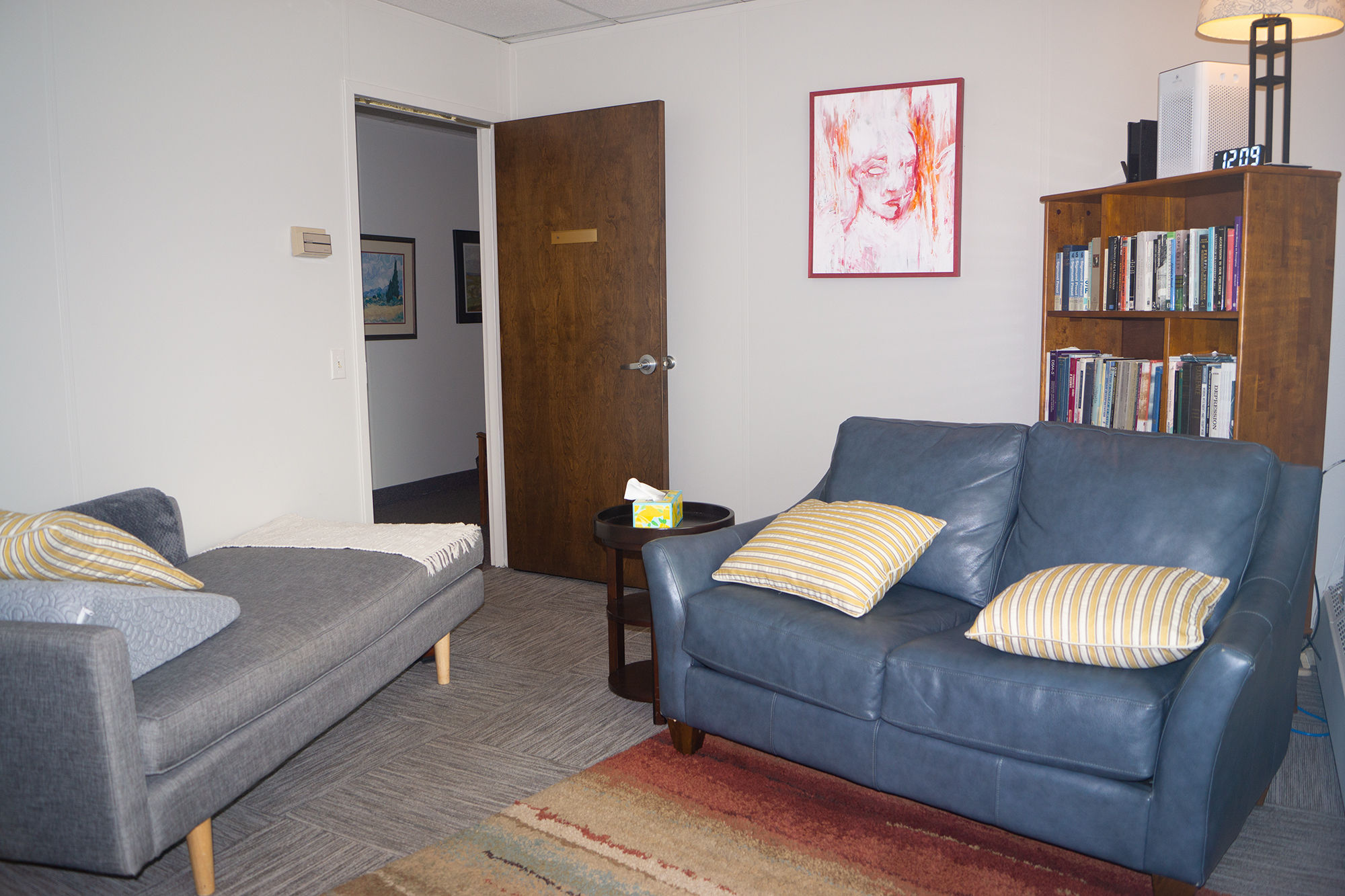
Dr. Lembaris's Office